
Ever spent hours, maybe even days, weighing a decision, only to end up still unsure? You scroll, you research, you make pros-and-cons lists… and somehow, nothing feels right. Deep down, you’re not just trying to make a “good” choice—you’re trying to avoid regret. But here’s the kicker: chasing the “perfect” decision might actually be the thing keeping you stuck.
Why the “Right” Choice Might Not Matter ✔️ ❌
We like to believe there are right and wrong decisions. But do they really exist? What actually makes a decision good or bad? And when we think we’ve made the “wrong” choice—how can we ever know the alternative would have been the “right” one?
Dr. Alok Kanojia (better known as Dr. K.), MD, MPH, psychiatrist at Harvard Medical School, explains this beautifully in this video.
Here’s the surprising truth: whether a decision feels right or wrong often has less to do with the choice itself—and more to do with how decisive we are.

The more indecisive we are, the more we hunt for the “perfect” choice, believing it will make us happier. Endless pros-and-cons lists, obsessive research, second-guessing—it’s all in the hope that the answer will magically appear.
Underneath it all, what we’re really afraid of is regret:
- Regret of missing out on something better.
- Regret of wasting time on a “wrong” decision.
- Regret of being less efficient than we could have been.
Sure, most decisions can be reversed. But we still think: If only I had made the right choice from the start, I wouldn’t have wasted all that time.
But is that really true?
If it were, then decisive people—those who make quick decisions without agonizing—should be the ones regretting the most, wasting more time, and missing out on opportunities. They should be making mistakes more often… right?
Not at all. In fact, it’s usually the opposite. Decisive people tend to stick with their choices and live happier, less regretful lives.
Why?
Because decisive people work with their decisions instead of against them. They accept mistakes as part of the process and focus on making things work. To an outside observer, it looks like they make fewer mistakes—and rarely have to second-guess themselves.
The indecisive person tries to make the right decision. The decisive person works on the decision they made.
Dr. Alok Kanojia
😬 Stuck in Indecision? 3 Problems and How to Fix Them 👌🏻
Sound familiar? Here are the three biggest traps that keep us stuck in indecision—and how they mess with our heads.
Problem #1: Fear of making a mistake
We’re afraid of picking the “wrong” option and regretting it later. That fear alone can freeze us in place, making every choice feel high-stakes.
👌🏻 Solution: Shift your mindset. There are no perfect choices—just decisions you make. Focus on what you do after making a decision. Decisive people aren’t happier because they always pick the “right” option—they’re happier because they commit and make it work.
Problem #2: Information overload
With endless resources at our fingertips, it’s easy to spend hours—or even days—researching every possible angle, hoping to guarantee the “right” decision. The trap? The more we research, the higher our expectations, and the bigger the disappointment when reality doesn’t match.
👌🏻 Solution: Be okay with mistakes. Ironically, accepting that things might go wrong actually helps you make fewer errors. Once you commit, you adapt and solve problems as they arise, instead of worrying about hypothetical issues that may never happen.
Problem #3: Procrastination and last-minute decisions
Putting off a decision until the last possible moment often forces us into a rushed choice. We assume the outcome will be worse simply because we didn’t plan perfectly—or because we panicked.
👌🏻 Solution: Accept regret as part of the process. Not every decision will feel amazing—and that’s fine. The alternative might have been worse—or exactly the same. Life isn’t perfect, so why should we expect perfect decisions or flawless outcomes?

Understanding why we struggle with decisions is just the first step. The real challenge is applying it in real life. These six tips give you concrete ways to make decisions easier and more satisfying.
6 Tips to Make Decision-Making Easier 🪶
Tip #1: Make your toughest decisions in the morning 🌄
Every decision costs mental energy. Imagine starting your day with a stack of coins—each decision you make spends one coin. That includes big choices… and small ones, like finally closing Instagram or deciding what to eat for breakfast.
As the day goes on, your “decision coins” run low. By evening, you may have only a few left—or none at all. This is called decision fatigue. In the morning, your brain is fresh, alert, and ready to tackle the tough calls. Later in the day, you’re more likely to make rushed or impulsive decisions.

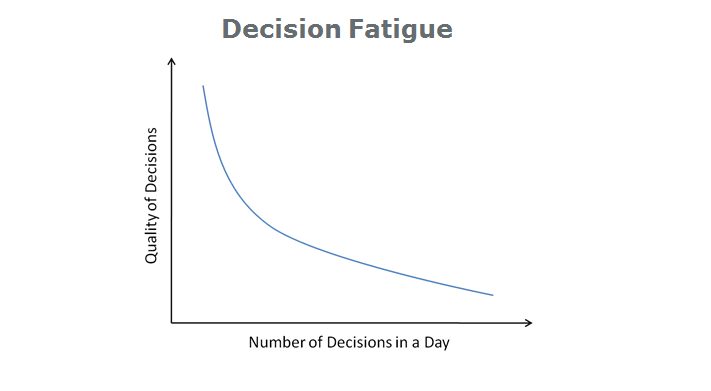
Even pop culture knows this. Ted Mosby from How I Met Your Mother once said:
Nothing good happens after 2 a.m. When it’s after 2 a.m. just go to sleep, because the decisions you make after 2 a.m. are the wrong decisions.
Avoid unnecessary decisions first thing in the morning. Even small choices, like checking emails or social media at breakfast, drain your mental energy.
Supermarkets exploit this too. Chocolate bars and gift cards are right by the checkout because shoppers’ mental energy is already depleted from dozens of decisions. A simple shopping list can help you resist these impulses—and it’s a perfect way to leverage your Second Brain.
🌄 Key Takeaway:
Your mental energy is limited. Make tough decisions in the morning when your “decision coins” are full, and save your brainpower for what really matters.
Tip #2: Fewer options, better decisions 📉
If you have too many choices, you go into what psychologists call choice overload, and then you have essentially no choices.
Bill Burnett
Ever felt overwhelmed by too many options? That’s exactly what Burnett calls choice overload—and it can make decision-making much harder than it needs to be.
A classic study by Sheena Iyengar & Mark Lepper (2000) illustrates this perfectly. In a California supermarket, customers were offered either 6 or 24 types of jam. When there were only 6 options, 30% bought a jar. When there were 24, only 3% made a purchase—even though more people stopped to taste the jams.
The more options we have, the harder it is to choose—and the more likely we are to regret our decision. This also explains why dating apps like Tinder can feel overwhelming: we can only meaningfully evaluate 5–7 options at a time.
📉 Key Takeaway:
Fewer options make decisions easier and more satisfying. Gather the facts first, then cut the clutter and commit.
Tip #3: Decide and don’t look back 🔒
Sometimes, the best way to be happier with a decision is to limit your ability to change it. Psychologist Dan Gilbert explains this beautifully in his TED Talk The Surprising Science of Happiness.

In one classic experiment, participants were asked to rank six Monet paintings from their favorite to least favorite. They could then take one painting home. Here’s the twist: half of the participants could swap their choice later if they changed their mind, while the other half had no option to change. The results were fascinating. Those who could swap their painting ended up liking it less, second-guessing their choice at every turn. Meanwhile, the group whose decision was final reported much higher satisfaction—even if their initial pick wasn’t their top-ranked painting. Just having a fixed choice made them appreciate it more.
In another experiment with Harvard students in a photography course showed a similar effect. Participants had to take many photos and then choose two to submit for grading. One group could exchange their chosen photo for another any time before the deadline, while the other group’s decision was final. Weeks later, students who couldn’t change their photo reported much higher satisfaction with their submission, whereas the group that could swap felt far less attached, constantly imagining if the other photo would have been better.
When a decision is final, we naturally adapt to it and often end up liking it more than we expected. Gilbert calls this “artificial satisfaction.”
Start small with minor decisions to build your confidence and train your brain to enjoy the outcomes.
🔒 Key Takeaway:
Commit to your decisions and resist the urge to backtrack—especially for decisions that aren’t high-stakes. The more final your choice, the more satisfied you’ll feel—often more than you expect.
Tip #4: Decisions on autopilot 🔁
Some decisions come around daily, weekly, or monthly. If we had to rethink each one every time, our brains would be overloaded.
Think about subscriptions. Do you really reconsider your Netflix plan every month? One friend of mine had been paying €50 monthly for a gym membership for two years without ever going—all because it was easier to let the decision run automatically. Automating decisions like this can actually work in your favor instead of against you.

Routines are another powerful tool. A friend lays out her workout clothes every evening, so deciding whether to bike to work in the morning isn’t even a question. Your morning self can focus on the important decisions instead of small choices. Even breakfast can be automated: eat the same thing each day, and your decision-making “coins” stay intact for more important tasks.
From subscriptions to morning habits, let your systems handle the small stuff so your brain can focus on the big stuff.
🔁 Key Takeaway:
Automate what you can and build routines. Free up your mental energy for decisions that truly matter.
Tip #5: Make quick “wrong” decisions ⏱️
Sometimes, taking too long to decide costs more time than making a small mistake. A friend of my brother always says:
A quick wrong decision saves time.
The idea is simple: for low-stakes decisions—like whether to order pizza or Chinese—don’t overthink it. Set a short time limit, then commit. You’re unlikely to suffer serious consequences, and you free up mental energy for more important choices.
Many companies use a similar principle. Employees can spend up to €100 without approval—saving the boss from unnecessary decisions and the team from delays. You can do the same in daily life: set a timer, make the decision, and move on.
⏱️ Key Takeaway:
Don’t overthink small choices. A fast decision, even if imperfect, saves time and mental energy. You can still adjust later if needed.
Tip #6: Delay when necessary ↩️
Not every decision needs to be made immediately. Sometimes, you lack enough information, are waiting on a deadline, or don’t have the right resources.
For example, if you receive an email on Friday evening that you can’t address until Monday, don’t open it. Postponing the decision prevents the “Damocles sword” of stress hanging over your weekend.
However, be careful not to delay decisions that won’t change later. I once agreed to help a former boss over the weekend. I said yes quickly, but right after hanging up, I realized I really didn’t want to spend my precious free time waitressing (I was already working as a physio back then).
Pre-preparing responses can help avoid these uncomfortable situations. Having a template ready for requests that affect your free time gives you better control. For example:
“Thanks for thinking of me! I already have plans, but I’ll reach out if something changes.”
This way, you stay in control because you can adjust your decision later if needed, while avoiding unnecessary mental load.
↩️ Key Takeaway:
Delay decisions strategically. Save energy for what matters, and don’t let minor choices weigh on you unnecessarily. Protect your time and energy by deciding when to decide.
📝 Key takeaways
- There are no truly “right” or “wrong” decisions—happiness comes from how you handle your choice, not the choice itself.
- Indecision usually stems from fear of regret, too much information, or procrastination.
- The key is to commit, work with your decisions, and accept mistakes as part of the process.
- Save mental energy for what matters: make important decisions when you’re fresh, limit unnecessary options, automate routines, and handle low-stakes choices quickly.
- Strategically delaying decisions can help, but act when a choice won’t change later.
Thanks for spending this time with me. Keep exploring, stay open to new ideas, and remember—growth is a journey, not a destination.
Take care,
Carina 🦊
6 thoughts on “⚡ How to Decide Faster and Feel Better About Choices.”